Monday, September 30, 2013

Paris at last-after 18 years!

Paris at last-18 years later


I finally reconnected with my beloved Paris after having been away for 18 long years.  It has changed and so have I but I still felt at home.

In preparation for my trip, I spent weeks studying maps of neighborhoods, reviewing the metro map and bus routes, watching YouTube travel guides, and brushing up on my French by listening to French language CDs and online programs, and more.

I also created a long list of more than 30 activities-each 1-4 hours in duration-in which to engage.  Also, I had a schedule of walking tours.

I kept this list with me at all times and slowly crossed off items, one at a time.  There are always places I miss and I save them for the next trip.

As a result, I was well-equipped with a variety of ideas about how to spend my time.

What I was not prepared for was the 6 of 7 days of rain that I encountered, in this city known as an "open-air museum".  Although the rain required me to dig deeply into my contingency-plan-bag -of -tricks, I was nonetheless able to thrive; in fact, I came, I saw, and I conquered. 


Here are some of the highlights of my trip:

·         My hotel was in a lively and interesting area of town.  Specifically, I stayed in a small, boutique hotel located only 10 minutes from Le Marais and Place des Vosges, and only 5 minutes from the bustling Bastille area. My metro line was #8 and it was a quiet, one-line stop.  Nearby, there was a plethora of choices for dining, shopping, neighborhood grocers, cafes, and boulangeries/pastisseries (bakeries).  The staff at my hotel was helpful and friendly.


·         I took 4 excellent walking tours conducted by smart, passionate, witty guides from a company that offers 3-6 daily tours, rain or shine.  They feature more than 20-themed tours.  My small group tours cost 12 euros each.  Here are the brief tour descriptions, of tours I took, written by Paris-Walks.com:

THURSDAY 2:30pm The Marais Circuit 2 Stories of royalty, mistresses and intrigue in this beautiful historic neighborhood. On circuit 2 we explore the Northern side of the Marais. Elegant classical mansions with graceful courtyards and gardens, the old Jewish quarter with the picturesque rue des Rosiers, and the peaceful place des Vosges, the city’s oldest square. Meet at metro St Paul There is always an extra tour on Sunday.

The famous L'aA du Falafel

Saint Paul

 
FRIDAY 10.30am Hemingway's Paris Explore this charming district in the Latin Quarter with the old houses of the Mouffetard market street, an impressive fragment of the medieval city wall, and the lovely historic church of St Etienne-du-Mont. It is associated with many writers: Joyce, Orwell, Balzac, Hugo, and Verlaine and immortalized by Hemingway in A Moveable Feast. Meet at metro Cardinal Lemoine.

I took this tour IN THE RAIN!


SUNDAY 10.30am The Village of Montmartre On this picturesque walk you will discover old winding streets, the vineyard, artists' studios (Renoir, Lautrec, Van Gogh) quiet gardens, historic cabarets, the place-du-Tertre with its artists and the Sacré Coeur Basilica. Meet at metro Abbesses (use the station elevator, it is quite deep!) (All year)


MONDAY 10.30am Ile de la Cité and Notre Dame Read the stories in the medieval sculptures, and hear how the cathedral was built. We explore the history and architecture of the Island, the old streets, the flower market, quiet gardens, secret courtyards and the poignant memorial to the deported. Meet at metro Cité. 

BTW, Notre Dame turned 850 this year


Love Locks Bridge


Lovers write names on lock and throw away key into Seine


Kelly & Kim locked in love for 30 years!!
 
Place Saint Michel
 
 
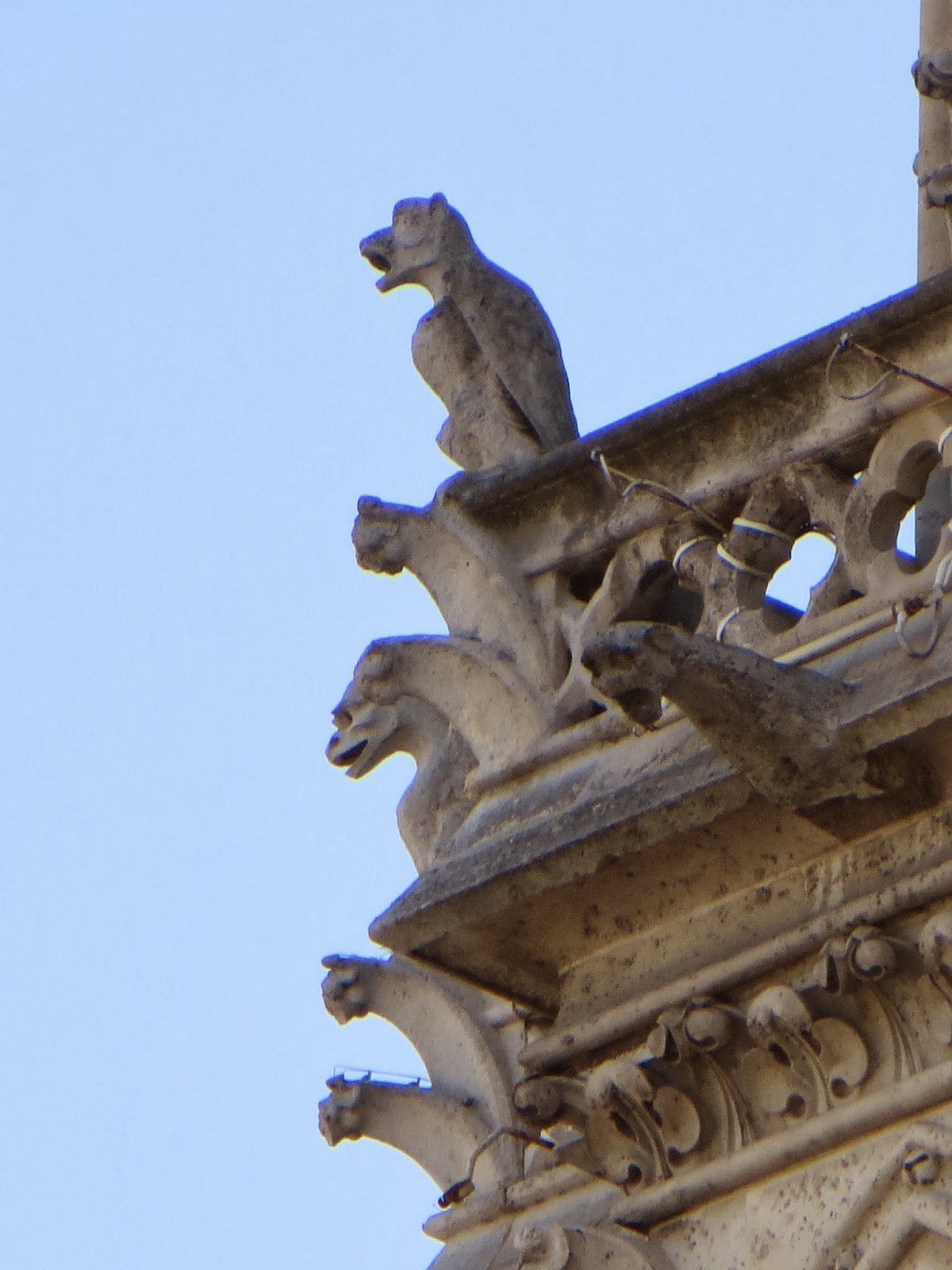
Notre Dame Gargoyles


·        La Cuisine.  I dined on some of my favorites including: steak frites, crepes, sandwich grecs, salade nicoise, quiche Lorraine, escargots, and fresh baguettes and pain au chocolats--hot from the oven.


Dinner with Susanne and Steve Zimmerman


16Euro formule


Salade Nicoise


·        Strolled in some of my favorite neighborhoods and places such as Latin Quarter, Bastille area, Mouffetard, Marais, Gare St Lazarre/Haussman, and Montmartre, I did A LOT of walking, even when I used the metro for transportation.


  •  Seeing young lovers everywhere


·        Visited the breathtaking and serene Jardin de Luxembourg.  It was as much of a feast for the eyes as I had remembered.


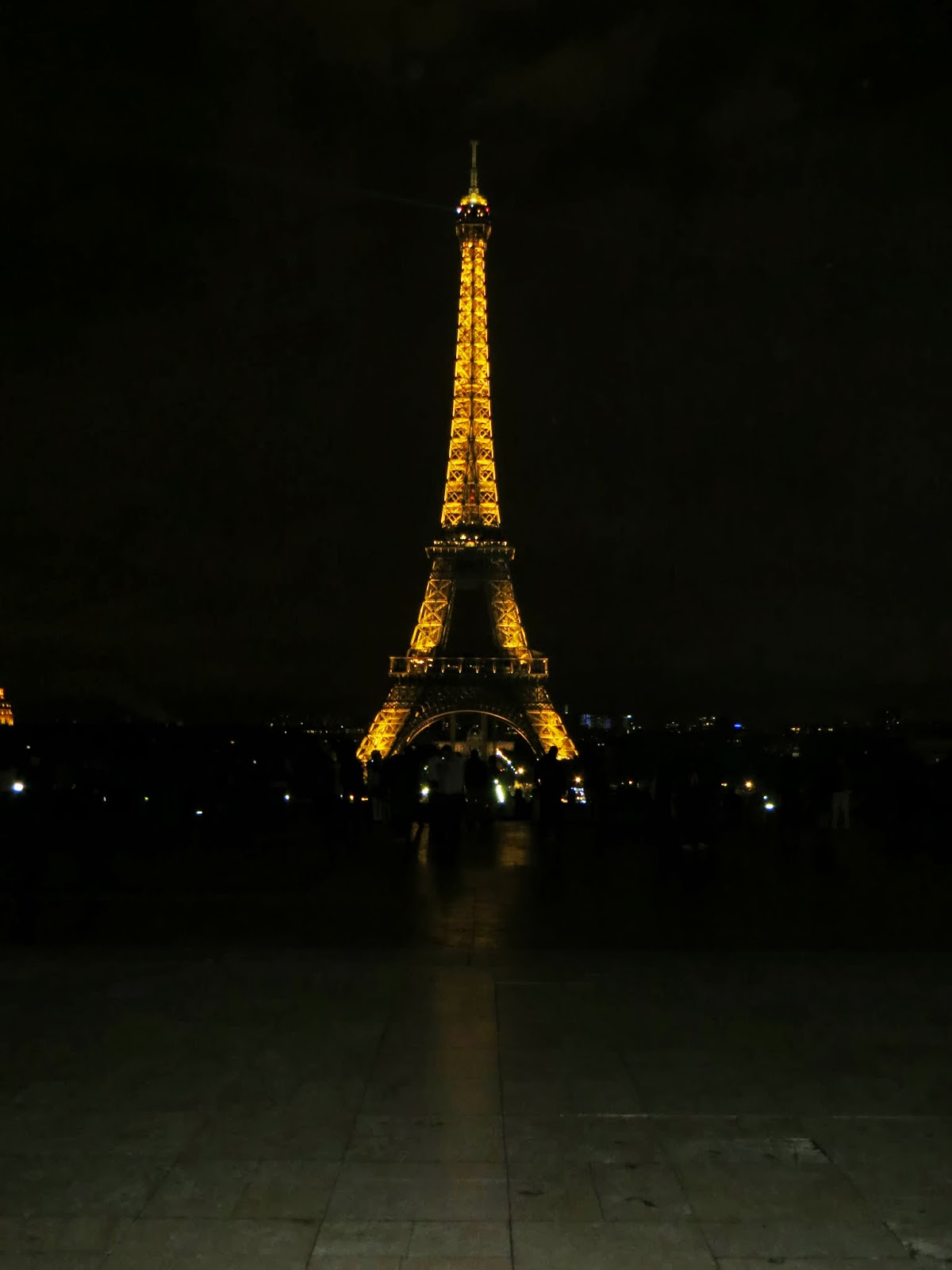
·        Took great photos with (and of) Paris’ monuments, both daytime and nighttime.


·        Took the metro and bus (28 rides total) all over Paris.  Yes, the metro is the most convenient and inexpensive method of traveling around the city.  I also really felt “a part of” while joining the masses on the daily trudge.  It is not glamorous, but it is authentic.  I used my Metro App to guide me on how to connect.  A book of 10 metro tickets cost 13euros30.  The single ticket price is 1,70€.   (September 2013)


See excellent article on how to use the Paris Metro here:


·         Enjoyed long, scenic city bus rides on routes that enabled me to see famous sites such as the Opera house and famous plazas such as the Place de la Republique, all above ground.  This is obviously a great alternative to taking the Metro because you are able to see all the sights along the way.  Also, whenever I took the bus, it was never crowded. I could easily get two or four seats to myself and I had ample room to take out my camera and snap sights along the way.  Bus line # 20 stopped right near my hotel, at my metro stop: Chemin Vert.  Of note, metro tickets are valid on city buses.


·         Having a meal from a pastry shop.  My favorite is to go window-shopping in a pastry shop and settle on a quiche Lorraine or quiche with 3 cheeses, freshly baked, hot from the oven.  These rich snacks cost under 3 euros.


Assorted quiches from my nearby boulangerie


Visited my favorite history museum of the city of Paris, Carnavalet.  This museum showcases art and artifacts of Paris with an emphasis on the Revolution and new republic periods.  What I like most is the variety of artifacts from the 17th, 18th and 19th centuries including metal shop signs, guillotine miniatures, personal items (hair combs, cutlery, pistols, hair of famous Parisians), and portraiture. 


·         Nightly strolls through vibrant areas.  Tops were lively quartiers of St Michel area, Champs-Elysées, Bastille area, and Le Marais. 


Here are some observations I made from the perspective of a former resident who had been away for decades:

Smoking is prohibited indoors.  The passage of anti-smoking laws in France really surprised and impressed me! I never thought I would see the day…… I noticed a difference this makes; I was free to sit indoors everywhere without being assaulted by others’ invasive, bad habits.

I was surprised to see electronic – cigarette storefronts.

Everyone is disengaging from the world around them because they are buried in activity with their smart phones – – just like everywhere else. This was especially noticeable on the metro where heads were looking down as people tapped away on their devices, oblivious to the world around them.

People spoke to me in French first in restaurants and cafés and other business establishments, and on the streets.

People often approached me and asked me for directions in French. I was flattered that a) I looked as though I knew what I was doing and b) that people presumed I was French.

I was surprised by how many French people speak English now.

Starbucks is everywhere in the tourist areas. They carry American-style desserts such as cakes, pastries and cookies and doughnuts etc.

People appear to look sad in the metro.

Blacks are still not integrated into society.  When I saw Black people, they were in clusters of two or three or four. There was an occasional Black person with a group of Whites, typically young women.

There are still musicians inside the Metro cars performing and asking for money after.  That has not changed.

Black is definitely a popular clothing color. I also remarked at the number of men wearing brightly colored pants such as red or orange or pink.
 
 I am still savoring the memories of having finally reconnected with my beloved Paris!!!!!

See my arrival Day Video here:


Thursday, August 8, 2013

Croatia Joins the EU

Croatia Joins the EU 
From ethnic slaughter to stability in two decades: Former war zone Croatia joins EU

By Alastair Jamieson, Staff writer, NBC News


Only 18 years after a peace deal ended violence that left the former Yugoslavia bloodsoaked and gave birth to the term "ethnic cleansing," Croatia is to join the European Union at midnight on Sunday.

It is a major milestone for Balkan countries trying to close the door on decades of Communist rule and the horrors of civil wars that tore apart communities along ethnic and religious lines.

But while European leaders trumpet the latest expansion of the economic bloc, celebrations may be muted in austerity-weary Croatia.

With its thousands of miles of glistening Adriatic coastline, modern highways and sidewalk cafes, Croatia looks as prosperous as its new cousins in western Europe.

That masks an economy crippled by soaring national debt, an unemployment rate of 18.1 percent and an economy heavily dependent upon tourism.

“I fear that we will become another Greece, another Cyprus,” said Vesna Mitrovic, who runs a vacation apartment near Dubrovnik – the historic city that became trapped in a six-month siege in 1991 and is now home to the Museum of Croatia’s War of Independence.

“I signed the petition against EU membership," she said. "I think we will become a small fish in a big pond.”

However Igor Nicolic, 84, of Sibenik, a town north of Split, said he was pleased to see his country join the EU.

 “I have seen World War II, the Iron Curtain and the breakup of Yugoslavia,” he said. “We always thought of ourselves as part of central Europe, so it is really good that we can now join the union. I think it will help with the corruption here and in the long run it will benefit all of us economically.”

He appears to be in the minority. In a poll this month by Ipsos Puls, only 7 percent of Croatians said they would be watching a fireworks display marking Monday’s occasion, Reuters reported. Forty-two percent said such a ceremony was unnecessary.

Croatia is not the first country to join the EU from behind the “Iron Curtain,” the Cold War divide that separated the West from the Communist countries of the Soviet Bloc. Poland and Hungary, for example, joined in 2004.

Nor is Croatia the first part of the Socialist Federal Republic of Yugoslavia to join: Slovenia, whose 1991 struggle for independence lasted a few weeks and claimed only 70 lives, was admitted in 2004.

However, Croatia is the first EU member among the protagonists in the post-1991 Balkan civil wars that also included Serbia, Bosnia-Herzegovina, Kosovo and Montenegro. By the time fighting ended in Kosovo in 1999, 140,000 lives were lost and more than a million people were displaced. 

Serbia could join the EU next year, it was announced Tuesday, with Montenegro next in line - once monitoring teams approve efforts to eradicate corruption and weak public governance. Bosnia-Herzegovina and Kosovo have yet to be formally adopted as candidates.

As well as passing economic tests to join the EU, these western Balkan countries were required to comply with efforts by the International Criminal Court in The Hague to bring war criminals on all sides to justice.

Croatia’s first post-independence ruler, autocratic nationalist President Franjo Tudjman, was facing investigation over his possible role in war crimes when he died in 1999. In 2005, Croatia took a significant step, handing over suspected war criminal Ante Gotovina – although he was cleared at the The Hague seven years later.

Fisherman Danilo Latin fears Croatia's accession to the European Union on July 1, and strict new laws and regulations that come with it, may drive the last nail into his industry's coffin.

“Croatia’s membership is part of the political agenda to normalize the Balkan countries,” said Professor Iain Begg, research fellow at the European Institute of the London School of Economics.

Former U.S. Ambassador to Bosnia-Herzegovina Richard Kauzlarich called Croatia’s entrance into the EU a “positive step” for both the country and the region as a whole.  

“I can remember the bad old days,” he said. “Croatia experienced a great deal of loss during the war, but the West, the U.S., the EU supported Croatia’s evolution and did everything we could to encourage the kind of leadership that would be necessary to undertake the EU process.”

Now a fellow at the Brookings public policy organization, Kauzlarich said that the country had resolved a lot of issues in order to join.

“I think if there is … a negative element out there it is that Croatia still has a significant corruption problem and they’re not going to be able to drop that because they’ve achieved this very important objective,” he added.

Croatia’s size means its accession will make more of a difference at home than across the rest of the EU. It is slightly smaller than West Virginia, and its 4.4 million citizens will represent less than one percent of the EU total.

Membership means it will qualify for Europe’s generous regional assistance programs – equivalent to federal aid in the United States – in which public money is spent on infrastructure projects that reduce the inequalities compared to wealthier members.

In March, the European Investment Bank approved a $150 million loan for the expansion of the Zagreb Airport, a key link with the rest of Europe. Cultural funds will also help protect Croatia’s heritage in places like Dubrovnik. 

Not all EU citizens are happy. Germany’s Bild magazine labelled Croatia "the new graveyard for our taxpayers' money,” a reference to the Berlin-led economic bailouts necessary to prevent the total collapse of other southern European nations including Greece, Spain and Portugal.

Instead of riding high on Monday’s accession, Croatia’s Prime Minister Zoran Milanovic was forced to address those concerns, saying his country “is not a rose garden but it is not a Greece, either.”

“My message to German taxpayers: We will cost you nothing," Milanovic said.

However, there are fears of a brain drain because EU membership also means fewer barriers to cross-border migration. A Facebook group, "Young people, let's leave Croatia" has attracted almost 60,000 likes.

"I'm happy we'll be able to seek jobs abroad and make more money," Zagreb computer science student Marko Jakic told Reuters. "But I'm also sad we can't do that in Croatia because our economy is bad and there are no jobs, even for us."

NBC News' Henry Austin and Reuters contributed to this report.


Tuesday, July 30, 2013

"Travel is the enemy of prejudice, bigotry and narrow-mindedness."


"Travel is the enemy of prejudice, bigotry and narrow-mindedness."

Here is a Ted Talk by Rick Steves, the American travel guru, tour guide, author and humanitarian, who spends 1/3 of his adult life living out of a suitcase.  I was moved by his presentation about how travel broadens his perspective and humanity.  I love the Mark Twain quote, “Travel is the enemy of prejudice, bigotry, and narrow-mindedness”.

I hope you enjoy this:


Monday, July 22, 2013

Don’t ask, What Are You? (EVER)


I continue to be plagued and labeled as “other” on a regular basis because people feel it is OK to ask, What Are You?

I wish they realized how it immediately creates distance because they imply, I am an outsider—not one of the gang--- something abnormal.


For the record, it is completely inappropriate to ask this question when it is not pertinent to the interaction.  In fact, there is rarely an occasion when this question is appropriate.


My response is usually, what do you mean? Or why do you ask?  Even when I respond with I am American, or I am from Chicago, the person who asks is not satisfied.  That is because the real question is, What Non-White Group are you from?  I just don’t want to directly ask this because it will make me sound small.


Here is an article written by a woman who advisors others on how to NOT ask this question.  I agree with her points.


If you haven't been able to surmise from my little avatar photo off to the side and my non-WASP name (although, sometimes I like to prance about in Victorian lace numbers and call myself Marjorie Altringham), I am Not a White Person. This means I am a walking version of this fun little game called "What Kind of Not White Person Are You?" Here's how it goes: I introduce myself to you at a party or some such social gathering. You introduce yourself as well. In an attempt to get to know me better, or maybe just keep the conversation going, you want to know exactly how I am a Not a White Person. Which is totally fine at the right time and place, because I love gabbing on about my immigrant parents and how much I love mango pickle. It's all good fun in post-racial America, like wearing a red, white, and blue dashiki on the fourth of July (who knew you could don a dashiki and be patriotic at the same damn time?!)

But the majority of the time I play this game, supposedly well-intentioned people curious about my brownness go about asking it in the wrong way. No, not the wrong way- the ASSHOLE way. I get it, really. You grew up in a suburb of Indianapolis and no one ever taught you how to not be an asshole. That's actually my life story, too, but you can't always throw Indianapolis under the bus as your excuse for being ignorant.

Fret not, dear reader. I'm here to sift through insane Yahoo! Answers and my own Brown Girl Feelings to tell you exactly how not to be an asshole when asking a Not White Person about their ethnicity. It's really very simple once you get the hang of it! Let's practice together, shall we?

HOW TO ASK ABOUT ETHNICITY: THE AXXXXXE WAY

Bring it up right away.

Hint: Do not do this:

-Hi, my name's _______.

-Nice to meet you, I'm ________.

-Cool. So, like, what is your ethnicity?

This is instantly othering. It might be okay to ask, "where did you grow up?" But even then, proceed with caution. It's fine to be curious, and asking about where someone grew up is a good way to figure out if they smoked weed for the first time in the back of a minivan next to a Dairy Queen or on a fire escape next to a vegan co-op. But asking about ethnicity right off the bat is an obnoxious way to ask about something that isn't really relevant to basic introductions. Ask how I know the host, or if I watched the game last night (I didn't). Unless I'm sporting a button that says, "Ask me about my ethnicity!" you really just need to let that burning desire to figure out my brownness go.

"No, but where are you really from?"

For most people, "where you're from" is where you grew up and lived for the majority of your life, or maybe the city where you were born. But asking where someone is really from is not the right way to figure out where my bushy eyebrows and gigantic nose are really from. (They're from ancient Mesopotamia, jerk!) Again, this is othering, making a person feel like they need to explain why they look the way they do.

"But like, where are your parents from?"

See above explanation. Rinse, repeat.

"Let me guess where you're from!"

The guessing game is the best way to make someone feel like a trivialized object for your viewing pleasure. People who play it sound like the Earl of Burma attempting to pinpoint the specific village from where some subject of the British Raj hails. My ethnicity is not a game, so save your guesses for Twenty Questions.

Say anything about me is "exotic."

Here's how the dictionary defines "exotic":

exotic: [ig-zot ik] adjective: of foreign origin or character; not native; introduced from abroad, but not fully naturalized or acclimatized: exotic foods; exotic plants.

Guess what? Everything everywhere in the world is non-native now. They have KFC in Japan and sushi in Sacramento. They've got Pakistanis in Norway and Norwegians in Nepal, etc. etc. It's called globalization, people, and it's made this colonial word obsolete. Nothing about my suburban-Indiana upbringing was exotic, let me tell you, so please refrain from describing me as such.

"What are you?"

Sigh. This question. There are many ways to answer it, like, "I'm hungry," "I'm human," or "I'm Tan Mom," but most often, the frenzied mix of anger and disbelief prevents me from answering with words, leaving me to the only other form of communication I know: rolling my eyes and a slow SMH, at best. Take this question, tie it to a rock, and throw it to the bottom of the retention pond in your neighborhood so no one has to hear it ever again.

HOW TO ASK ABOUT ETHNICITY: THE NON-AXXXXXXE WAY

Don't ask at all.

Seriously, the best way to find out is to let someone volunteer the information.

"What's your ethnicity?" (At the appropriate time and place)

See! It's not so hard! Ask when it's appropriate, like when you're about to make a racist joke about an entire people and you want to cover your bases. JK don't do that. Being curious about someone's ethnicity is perfectly fine, but just be aware that how and when you ask it has an impact on people, and if you're an asshole about it, the impact is othering. I've never been curt enough to say it when people ask me about my ethnicity, but the question that always pops up in my mind is, "Why? Why do you need to know at this particular time?" Ask yourself why you're doing it before you question someone about their background. If their ethnicity is relevant to the conversation, or perhaps you're at a point in your friendship where the question is appropriate, then it's fine. But chances are, if you're asking just to ask, you really just shouldn't.

In the words of Dodai, "Keep yourself in check and don't be a jerk." It's that simple.

Tuesday, June 25, 2013

When can you legally travel without a passport?

Who, what, why: When can you legally travel without a passport?

see this article by: By Tom Geoghegan of the BBC News Magazine, Washington


Fugitive Edward Snowden is hoping to get to Ecuador, despite not having a valid passport. So when can you legally travel without one?

The US state department has revoked Snowden's passport and asked other countries to prevent him from travelling.

Wanted on espionage charges, the American flew from Hong Kong to Moscow on 23 June - using his US passport, according to one of his lawyers - and has applied for asylum in Ecuador.

On Monday, a seat was booked in his name on a flight to Cuba, but he was not seen on board.

A passport is usually a condition of international travel, so under what circumstances can one travel without one?

According to Wikileaks founder Julian Assange, Snowden has a "special refugee travel document" issued by Ecuador.

Millions of refugees cross borders without passports as they flee persecution or fighting.

In 2012, more than seven million people became refugees, according to the United Nations.

Without passports, people would be expected to present some other form of identification, says Larry Yungk, a UNHCR resettlement officer. Some refugees can be registered at a border with no identification at all.


The answer

  • Refugees cross borders with other forms of identification or none at all
  • The US issues 60,000 I-94 documents a year to refugees without passports
  • Consulates provide papers for people who have lost passports abroad
  • National ID cards are acceptable for travel between certain countries
  • The British Queen has no passport

"It's really up to the receiving country whether they wish to accept someone into their country without a passport," says Lavinia Limon, president and chief executive officer of the US Committee for Refugees and Immigrants.

The US admits about 60,000 refugees a year from all over the world, she says, and only a handful have passports.

They are each interviewed overseas face-to-face by officials from the Department of Homeland Security to establish whether they are genuine refugees and meet admission criteria.

A document called an I-94 is issued in lieu of a passport and travel to the US is arranged for each one.

"Let's say we're taking people from Malaysia and they have to stop in Hong Kong before they can get to LA," she says. "Hong Kong recognises these are US travel documents and lets them through."

Other countries such as the UK and Canada issue similar documents, as does the International Red Cross.


If a particular state wants to allow someone to travel on a state-owned airline, they have the right to do that without even issuing papers, says extradition lawyer Douglas McNabb, if the receiving country agrees.

You can also travel without a passport if it is stolen or lost while abroad.

"You can hang around for days waiting for a new passport," says Simon Calder, travel editor of the Independent newspaper. "Or you can get on a plane with something from your consulate that says 'this person is OK, let him or her take a one-way flight to their destination.'

"But it's rare and any kind of document like that is a get-out-of-jail-free card - go straight to your destination and don't mess around."

There are also special relationships between countries that entitle their citizens to travel between them without a passport.

For example, US citizens can travel to US territories like Puerto Rico and Guam with approved photo ID.

Beyond that, Americans always need a passport to travel by air, although US and Canadian citizens can visit each other's countries with pre-approved Nexus cards.

There are some exceptions to the mandatory passport rule if American citizens are visiting other North American countries by land or sea, according to the US State Department website.

So if they are going to the Caribbean or Bermuda, for example, then a passport card, rather than the passport book, will be accepted. And an enhanced driving licence or military identification can also be sufficient.

The UK and the Republic of Ireland have formed the Common Travel Area, in which photo ID is usually sufficient for citizens of both countries. Immigration officers can ask for proof of nationality, so government advice is to carry one.

In 1995, 26 European countries formed the Schengen area of free travel without border controls. But passenger carriers such as airlines can still impose identity checks that may include a passport.

National identity cards are also accepted in place of passports for member countries of some regional alliances.

These include the Economic Community of West African States, the European Union and some neighbouring countries, the Cooperation Council for the Arab States of the Gulf, and Mercosur in South America.

Not that Queen Elizabeth II has ever to worry about carrying one. As the person who officially issues them, she is the only Briton who is exempt.

Monday, June 24, 2013

Do you speak Touriste?

Apparently, Parisians are attempting to mend their nasty ways by adapting a friendly attitude toward their tourists.  Where you thinking, "It’s about time?"         See the attached article:

How to Be Nice to Tourists: A New Manual for Snooty Parisians


Do you speak Touriste?

By Mackenzie Yang June 24, 2013

Are the French finally feeling the pinch of their struggling economy and embracing the concept that “it pays to be nice”? Tourism offices in Paris–a city notorious for being unwelcoming to foreigners–are hoping to avoid losing tourists to friendlier destinations by distributing a handbook on being more courteous, reports Reuters.

Titled, ”Do you speak Touriste?”, the small pamphlet has friendly greetings in 8 languages, including Spanish, Italian and Chinese. It also offers suggestions to help locals better understand how visitors from various countries prefer to be addressed. “The British like to be called by their first names,” the guide explains, while Italians should be shaken by the hand, and Americans like to be reassured on prices. Regarding the Chinese, which Reuters describes as the fastest-growing group of visitors traveling to France’s capital, the guide describes them as “fervent shoppers” and advises that “a simple smile and hello in their language will fully satisfy them.”

Brazilians apparently pose a special challenge to a city known for exchanging the ultimate air kiss as a greeting. According to Reuters, the guide suggests offering to speak English to Brazilians — who are described as warm, “readily tactile” and keen on evening excursions — by telling them: “Nào falo Português mas posso informar Inglês.” (Rough translation: “I don’t speak Portuguese, but I can speak English.”)

With tourism supplying 1 in 10 jobs in the Paris area, 30,000 copies of the manual are currently being passed out to taxi drivers, waiters, hotel managers and sales people in areas ranging from the banks of the Seine river up to hilly Montmartre as well as in nearby Versailles and Fontainebleau, according to the report.