Showing posts with label intercultural. Show all posts

Saturday, June 21, 2014

Istanbul from cruise ship May 2012


Istanbul


I experienced one of the most wonderful visits to one of the most historically significant cities in the world.  I chocked as much into a day and a half as is possible and found every minute invigorating.  For 2 days, we visited Istanbul, the only city in the world, which straddles both Asia and Europe (split in two by the Bosporus Straights).


A special aspect of the visit was having spectacular views (from our ship) overlooking the Bosporus Straight (and Golden Horn) of key sites including Hagia Sophia, Topkapi Palace, and The Blue Mosque with its 6 minarets.  I had breakfast and dinner overlooking this spectacular water view.


Because Istanbul IS a port city, we had easy access from the ship.  Within minutes (or a short tram ride) a cruise passenger can enjoy major sites.  On our second day, I took the tram from Trophane to Eminonu, to begin my tour. I loved the frenetic energy of the city and felt comfortable touring around on my own, day 2.


Touring around, I felt the glory/power of this once mighty city that served as capital of two of the world’s most powerful empires Byzantine (for 900+ years) and Ottoman Empire (for 600+ years).  The Ottoman Empire was an economic, military, and religious powerhouse that ruled a huge chunk of the world spanning, Europe, Asia, and Africa from the 14th till the 20th century.


As we docked in Istanbul in the early morning, we were greeted by a robust and lively folk band of musicians dressed in traditional Turkish decorative uniforms.  I was able to zoom in and capture great close ups of them right from my private balcony.


I met my private tour group (of threee couples I met online) in our usual spot, across from the tour desk on deck 3.


We joined our tour guide, Ozlem (ozlemaydin33@gmail.com), who directed us to our bus, whose driver took us directly to the site-filled area: Sultanahmet.  Sultanahmet is the Old Town, where the city’s top landmarks are concentrated---including Hagia Sophia, Topkapi Palace, The Blue Mosque, The Basilica Cisterns, Hippodrome Square, and the nearby The Grand Bazaar.


Here are some comments/reflections about my time in Istanbul:


We only used the bus twice: at the beginning and end of our day.  Traffic was very congested (a new James Bond movie was being filmed) and the Old Town is best explored on foot.


Sultanahmet Park, situated between the Hagia Sophia and Blue Mosque, provides a great photo opp for both grand structures.


The Hagia Sophia is one of the most impressive buildings in the world and the crowning achievement of the Byzantine Empire.  Constructed by Emperor Justinian during the 6th century, it remained the largest basilica in the world for centuries and the remains the worlds 4th largest ever built.  It served as the Patriarchal church of Constantinople nearly a millennium until the Ottomans captured Constantinople in 1453.  Although the Ottoman Turks were Muslim, they were so captivated by the cathedral’s grand scale and beauty, they chose to preserve rather than destroy it.  Instead, they converted it to a mosque adding minarets, covering Christian mosaics and frescoes with Islamic artwork, and adding an imam’s pulpit and mihrab facing Mecca, among its many modifications.  After the secular Republic of Turkey was established, the Hagia Sophia was converted to a museum in 1936.  As a result, many (well-preserved), original Christian frescoes, which had been plastered over with whitewash, were uncovered and are now on display.  The eight iconic 24-ft wide leather medallions with Arabic calligraphy continue to dominate the apse, center and arches above the imperial gate. 


The Blue Mosque was the first mosque outside Mecca to have six minarets, likely a display of the Sultan’s wealth.  In order to avoid upstaging the central mosque in Mecca, which had six minarets, Sultan Ahmet I financed construction of a  seventh minaret there.  Construction of this mosque marks the beginning of the Ottoman Empire’s decline because it exhausted the treasury that was never restored due to a succession of wars and incompetent rulers.


I saw the famous Medusa heads in the underground Basilica Cistern (the vast, dimly-lit, former underground water reservoir, built in the 6th century).


The Waterway intersection of The Golden Horn, Bosporus Straight, and Sea of Marmara is one of the busiest in the world.  There was a continuous flow of ferry, barge, commercial ship, cruise ship etc. traffic.  With its spectacular views, it’s no wonder that Sultan Mehmet The Conqueror chose to this prime location on which to build his Topkapi palace.


We had a delectable and inexpensive lunch at Buhara 93 (Nakilbend Caddesi 15-near the Hippodrome).  I ordered the chicken Kebab with rice and salad for 8 or 9TL.  They have open wood-fired ovens where you can watch men baking the famous lavas (flat bread).  (It really is mentioned in Rick Steve’s guide, as their sign says)


I found the vendors at the Grand Bazaar (and Spice market) to be in-your-face aggressive.  The whole experience can be a bit overwhelming at first, but, the loud, colorful, crowded covered malls grow on you after a while.  The opening line in Turkish bazaars is always, “Where are you from”?  I am always delighted when vendors cannot guess where I am from since they are generally skilled at discerning the heritage of tourists. My favorite line was, “How can I hassle you today?”.  My favorite sign was “Real Fake Watches Sold Here”. There are more than 4000 stalls in a maze of streets in the grand bazaar selling carpets, ceramics, jewelry (gold, silver, precious/semi-precious stone, byzantine replicas), textiles, copperware, mosaics, spices, Turkish handicrafts, clothing, water pipes, Turkish delights, Evil eye merchandise, and of course, souvenirs, and more. 

see video


On my next visit, I will go to the bustling Taksim Square and Istikal Cadessi (Street) via the tram and funicular.




Wednesday, May 7, 2014

It just became harder to be female or gay in Brunei.

As a world traveler who aspires to see the world, (and has visited 73 countries/nations year-to-date),
I have little interest in visiting nations known for oppressive laws among certain groups, depriving them of basic civil rights.  Women and gays are often singled out as targets for these oppressive laws.  Sharia Law represents the most extreme.


Here is a sobering article that discusses Sharia Law and how Brunei, the first East Asian country to adopt Sharia Law, will implement it.  See link to article here: http://www.policymic.com/articles/88733/it-will-soon-be-legal-to-stone-g


It Will Soon Be Legal to Stone Gay People to Death in This Country


By Lauren Davidson  May 1, 2014


It just became harder to be female or gay in Brunei.

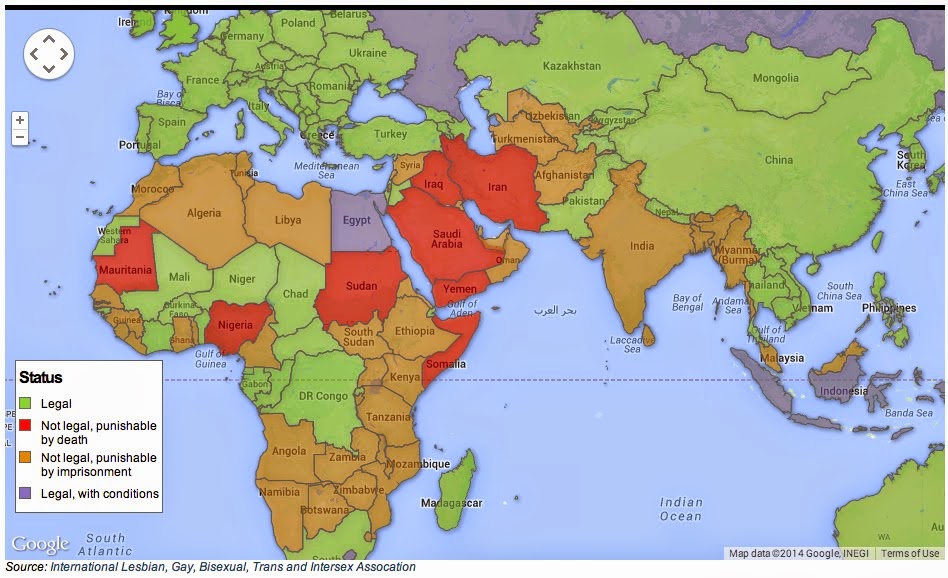
Brunei will be introducing its Islamic legal system in three phases. As of May 1, failure to attend Friday prayer services and pregnancy outside of marriage could result in fines or imprisonment. The second phase, to be implemented next year, will see theft punishable by amputation. By 2015 crimes such as blasphemy, adultery and consensual homosexual sex will warrant the death penalty by stoning.


Sultan Hassanal Bolkiah, the nation's absolute monarch, first proposed sharia law in the 1990s, and has called Islam a "firewall" against globalization, rising crime and modern influences like the Internet. 


Brunei, which shares the island of Borneo with Malaysia and Indonesia, already followed stricter Islam-inspired laws than its neighbors, banning the sale of alcohol and restricting the practice of other religions. Around 70% of its 412,000-strong population are Malay Muslims, but even non-Muslim Bruneians (who are mostly of Chinese descent) will be subject to the sharia code.


The UN criticized the move, saying the punishments constitute torture and are therefore illegal in the eyes of international law. The UN's spokesman for the high commissioner for human rights pointed to several studies that show that women are more likely to suffer at the hands of sharia law, due to deep-seated discrimination and stereotyping in the justice system. 


Although cases under the new sharia law will require an extremely high burden of proof and judges have been urged to act with discretion, criminalizing homosexuality and limiting female autonomy have a chilling effect and create an environment that negates human rights and inhibits personal freedom. This chilling effect is clear in other countries where homosexuality has recently been criminalized, such as Uganda. That country's strict anti-gay laws has already led to instances of anti-gay bigotry, including the public outing of reported members of the LGBT community by Ugandan tabloids.


In Brunei specifically, the changes "may open the floodgates for further human rights violations against women, children and other people on the basis of sexual orientation and gender identity," the Asia Pacific Coalition on Male Sexual Health and Islands of Southeast Asian Network on Male and Transgender Sexual Health said in a statement.


They added that the sharia penal code "significantly impacts the lives and sexual health of its citizens most vulnerable to HIV: men who have sex with men, transgender people and young people from key populations. Under this light, penalties directed to sexual relations between two consenting adults impede rights to health, privacy, confidentiality and equality before civil law."


Several countries have been adopting more progressive attitudes toward the LGBT community in recent years, decriminalizing homosexuality and legalizing same-sex marriage. Yet other nations are taking steps in the opposite direction: In February, Uganda passed a bill that makes "aggravated homosexuality" punishable with life imprisonment, just weeks after India's Supreme Court overturned a lower-court ruling, reinstating a ban on gay sex, punishable by up to 10 years in jail. 


Previously the maximum punishment in Brunei for gay activity wasa 10-year prison sentence. Homosexuality is illegal in around 80 countries, and Brunei now joins a handful of countries (spread across the Middle East and West Africa) where consensual gay sex — living openly, comfortably and naturally — could cost you your life. 


Image credit: CBC News


News of the legal changes in Brunei has so far been met with outrage and dismay by activists around the world, including in the U.S. In Los Angeles, activists have banded together to boycott the landmark Beverly Hills Hotel, after it was revealed that the famous spot was owned by a development company controlled by the Sultan of Brunei, Hassanal Bolkiah. Even influential television host Ellen Degeneres has lent her support to the boycott, notifying her social media followers that she will be staying elsewhere for the time being.

Thursday, August 8, 2013

Croatia Joins the EU

Croatia Joins the EU 
From ethnic slaughter to stability in two decades: Former war zone Croatia joins EU

By Alastair Jamieson, Staff writer, NBC News


Only 18 years after a peace deal ended violence that left the former Yugoslavia bloodsoaked and gave birth to the term "ethnic cleansing," Croatia is to join the European Union at midnight on Sunday.

It is a major milestone for Balkan countries trying to close the door on decades of Communist rule and the horrors of civil wars that tore apart communities along ethnic and religious lines.

But while European leaders trumpet the latest expansion of the economic bloc, celebrations may be muted in austerity-weary Croatia.

With its thousands of miles of glistening Adriatic coastline, modern highways and sidewalk cafes, Croatia looks as prosperous as its new cousins in western Europe.

That masks an economy crippled by soaring national debt, an unemployment rate of 18.1 percent and an economy heavily dependent upon tourism.

“I fear that we will become another Greece, another Cyprus,” said Vesna Mitrovic, who runs a vacation apartment near Dubrovnik – the historic city that became trapped in a six-month siege in 1991 and is now home to the Museum of Croatia’s War of Independence.

“I signed the petition against EU membership," she said. "I think we will become a small fish in a big pond.”

However Igor Nicolic, 84, of Sibenik, a town north of Split, said he was pleased to see his country join the EU.

 “I have seen World War II, the Iron Curtain and the breakup of Yugoslavia,” he said. “We always thought of ourselves as part of central Europe, so it is really good that we can now join the union. I think it will help with the corruption here and in the long run it will benefit all of us economically.”

He appears to be in the minority. In a poll this month by Ipsos Puls, only 7 percent of Croatians said they would be watching a fireworks display marking Monday’s occasion, Reuters reported. Forty-two percent said such a ceremony was unnecessary.

Croatia is not the first country to join the EU from behind the “Iron Curtain,” the Cold War divide that separated the West from the Communist countries of the Soviet Bloc. Poland and Hungary, for example, joined in 2004.

Nor is Croatia the first part of the Socialist Federal Republic of Yugoslavia to join: Slovenia, whose 1991 struggle for independence lasted a few weeks and claimed only 70 lives, was admitted in 2004.

However, Croatia is the first EU member among the protagonists in the post-1991 Balkan civil wars that also included Serbia, Bosnia-Herzegovina, Kosovo and Montenegro. By the time fighting ended in Kosovo in 1999, 140,000 lives were lost and more than a million people were displaced

Serbia could join the EU next year, it was announced Tuesday, with Montenegro next in line - once monitoring teams approve efforts to eradicate corruption and weak public governance. Bosnia-Herzegovina and Kosovo have yet to be formally adopted as candidates.

As well as passing economic tests to join the EU, these western Balkan countries were required to comply with efforts by the International Criminal Court in The Hague to bring war criminals on all sides to justice.

Croatia’s first post-independence ruler, autocratic nationalist President Franjo Tudjman, was facing investigation over his possible role in war crimes when he died in 1999. In 2005, Croatia took a significant step, handing over suspected war criminal Ante Gotovina – although he was cleared at the The Hague seven years later.

Fisherman Danilo Latin fears Croatia's accession to the European Union on July 1, and strict new laws and regulations that come with it, may drive the last nail into his industry's coffin.

“Croatia’s membership is part of the political agenda to normalize the Balkan countries,” said Professor Iain Begg, research fellow at the European Institute of the London School of Economics.

Former U.S. Ambassador to Bosnia-Herzegovina Richard Kauzlarich called Croatia’s entrance into the EU a “positive step” for both the country and the region as a whole.  

“I can remember the bad old days,” he said. “Croatia experienced a great deal of loss during the war, but the West, the U.S., the EU supported Croatia’s evolution and did everything we could to encourage the kind of leadership that would be necessary to undertake the EU process.”

Now a fellow at the Brookings public policy organization, Kauzlarich said that the country had resolved a lot of issues in order to join.

“I think if there is … a negative element out there it is that Croatia still has a significant corruption problem and they’re not going to be able to drop that because they’ve achieved this very important objective,” he added.

Croatia’s size means its accession will make more of a difference at home than across the rest of the EU. It is slightly smaller than West Virginia, and its 4.4 million citizens will represent less than one percent of the EU total.

Membership means it will qualify for Europe’s generous regional assistance programs – equivalent to federal aid in the United States – in which public money is spent on infrastructure projects that reduce the inequalities compared to wealthier members.

In March, the European Investment Bank approved a $150 million loan for the expansion of the Zagreb Airport, a key link with the rest of Europe. Cultural funds will also help protect Croatia’s heritage in places like Dubrovnik. 

Not all EU citizens are happy. Germany’s Bild magazine labelled Croatia "the new graveyard for our taxpayers' money,” a reference to the Berlin-led economic bailouts necessary to prevent the total collapse of other southern European nations including Greece, Spain and Portugal.

Instead of riding high on Monday’s accession, Croatia’s Prime Minister Zoran Milanovic was forced to address those concerns, saying his country “is not a rose garden but it is not a Greece, either.”

“My message to German taxpayers: We will cost you nothing," Milanovic said.

However, there are fears of a brain drain because EU membership also means fewer barriers to cross-border migration. A Facebook group, "Young people, let's leave Croatia" has attracted almost 60,000 likes.

"I'm happy we'll be able to seek jobs abroad and make more money," Zagreb computer science student Marko Jakic told Reuters. "But I'm also sad we can't do that in Croatia because our economy is bad and there are no jobs, even for us."

NBC News' Henry Austin and Reuters contributed to this report.


Monday, May 20, 2013

Burma v Myanmar – what's in a name?


Burma v Myanmar – what's in a name?

Obama sidesteps political storm by referring to former pariah as both Burma and Myanmar
By Jason Burke of guardian.co.uk, Monday 19 November 2012

 
Burma v Myanmar – Barack Obama's use of the latter during his visit to the country was described by his hosts as 'very positive'.


What's in a name? A lot if you're a south-east Asian country emerging from decades of military dictatorship.

The British, during their time as colonial overlords, referred to Burma and to its principal city Rangoon. Early independence fighters did not see any problem with this, nor for several decades did the army generals who took power in 1962.

But, after widespread pro-democracy protests in 1988, things changed and Burma became Myanmar, or, more specifically, the Republic of the Union of Myanmar; Rangoon became Yangon.

Some countries recognised the change. Others, such as the US and the UK, did not. As both names are used in the country – Burma is more popular, Myanmar is more literary – the decision was rooted more in a desire to show disapproval for the noxious regime.

President Barack Obama had reportedly considered avoiding either name but in the end used both Burma and Myanmar on Monday during his short visit to the country.


The use of the latter pleased his hosts – the Myanmar presidential adviser, Ko Ko Hlaing, called the wording "very positive" and an "acknowledgement of Myanmar's government" – but White House officials were quick to play down the move as a "diplomatic courtesy".


The debate is almost exclusively confined to the English language. The national anthem still refers to bama pyi or the "country of Burma".