Showing posts with label Greece. Show all posts

Monday, September 22, 2014

The Black Sea a vital trading center linking Europe with Asia.

The Black Sea

The Black Sea is steeped in history and culture, a vital trading center linking Europe with Asia.


Soon, I will embark on a 12-night (round trip from Istanbul), cruise of the Black Sea (plus Greece).  I will visit ports in Turkey, Romania, and Bulgaria.  I will have visited 4 of the 6 countries bordering the Black Sea, including Russia.  Of note, The Ukraine was originally part of the itinerary before the military conflict with Russia, earlier this year.
The Black Sea
 
Named Pontus Exinus ("the inhospitable sea"), the Black Sea was navigated and its shores colonized by the Greeks as early as the eighth century before Christ and later by the Romans in the third to first centuries B.C.


Many of the colonial and commercial activities of ancient Greece and Rome, and of the Byzantine Empire, centered on the Black Sea. After 1453, when the Ottoman Turks occupied Constantinople (and changed its name to Istanbul), the Black Sea was virtually closed to foreign commerce. Nearly 400 years later, in 1856, the Treaty of Paris re-opened the sea to the commerce of all nations.

Among its vast historical riches, the Black Sea region is home to the legend of Jason and the Argonauts and their search for the Golden Fleece, and the Biblical account of Noah's Ark. Troy, Constantinople, Istanbul, Sevastopol, Odessa, and Yalta are just a few of the names in this coastal area that have been etched in world history.

From the Crusades to the recent collapse of the Soviet Union, the Black Sea has witnessed often-tumultuous religious and political change. In the face of countless conquests through the ages, the people of the Black Sea region have endured, and today represent a remarkable mixture of cultures and religions.


Today, this ancient sea means many things to the people who live on its shores. Still vitally important as a regional trading center, with major ports dotting its coast, the Black Sea continues to provide its inhabitants with treasured resources — major commercial fisheries, a diversity of marine life, world-class beaches, and perhaps a more tangible record of our past than previously imagined. The recent discovery of ancient wooden ships in the Black Sea, well-protected from shipworm attack in the oxygen-deprived waters, points to the new wonders these ancient waters may yield.

The Black Sea and its six bordering countries — Bulgaria and Romania on the west, Ukraine on the north, Russia and Georgia on the east, and Turkey on the south — each have rich histories and cultures worthy of considerable exploration.

Friday, August 3, 2012

Olympia, Greece-site of the ancient Olympic Games

posted November 22, 2011

Today (11-23-11), our ship stopped in Katakolon, a small port located in southern Greece known for its proximity to the ancient site of Olympia—yes, THE Olympia where the ancient Olympics began in 776BC and lasted more than 1200 years. The games began as a tribute to Zeus and to celebrate character and balance of body and soul, as well as beauty and nobility.

At a time when incessant wars between city states were causing massive destruction and death, the King of Greece decided to call a truce and allow its best soldier athletes to fight on an athletic battlefield. Initially, the contests were divided into those in the nude and horseracing. The first nude races were footraces and gradually grew to include a pentathlon of sports of military skill in 706BC: javelin, discus thrower, jumping, wrestling, and foot racing. Later, boxing and chariot races were added.

On your mark, get set, go..........!


Winners, who wore a wreath from the sacred olive tree, were transformed into virtual gods when they returned home, heralded as heroes for a lifetime. Strict rules governed participants requiring them to be Greek citizens, devoid of accusation of murder, and violation of game rules. In addition, judges, athletes’ trainers, and spectators followed a rigid set of requirements.
Women, who had their own competition before or after the games, were not allowed to be spectators.

We visited both the archeological site and the museum that houses artifacts excavated from the site.

The Archeological Site

Here we saw the gymnasiums, temples were prayers and sacrifices were offered, Olympic village, the race track, and more. We even took photos from the original footrace starting blocks.

Today, Olympic flame of the modern-day Olympic Games is lit by a reflection of the sunlight in a parabolic mirror at the restored stadium and then transported by torch to the place where the games are held. The first such torch was carried to Berlin in 1936. In 2012, the flame will be carried from this very spot to London.

The ancient Olympics ended 393AD when the Christian Emperor banned all form of pagan worship including these international games. Later, earthquakes, northern invaders, and flood damaged and eventually covered the site under 12 ft of silt. It is a wonder the site was excavated and rediscovered by a monomaniacal German archeological team beginning in 1875.

The modern Olympics were revived and were held for the 1st time in centuries in Athens in 1896 with 44 contests and 13 countries. Subsequent Olympics were held in Paris, St Louis, London, Stockholm, Antwerp, Amsterdam, LA, Helsinki, Melbourne, Rome, Tokyo, Mexico City, and so on.

The games were only stopped during WWI and WWII.

After we toured the site, we toured the impressive (nearby) archeological museum that houses hundreds of spectacular artifacts including statues, helmets, coins, terra cotta objects, and gold items.

Our visit ended with a stroll among the harbor front cafes and shops. Efharisto, parakalo, kalimera. I still remember a bit of Greek!

We had perfect sunny, cool weather for our tour with a knowledgeable, passionate, humorous guide.

I will certainly have special thoughts about the Olympics from now on………….
Olympia Archeological Museum


Queen Victoria in Katakalon, Greece
update Feb 2, 2012:


Ancient Greek Museum Attacked And Looted By Armed Robbers

Huffington Post UK First Posted: 17/02/2012 09:18 Updated: 17/02/2012 10:29

Robbers in Greece have stolen dozens of artefacts of "incalculable value" from a museum in Ancient Olympia.

Local officials said the Archaeological Museum of Olympia was attacked by armed robbers.

The museum, which is known as the birthplace of the Olympic games, was hit in a planned attack on Friday at around 7.30 am.

The thieves broke in using hammers, according to local media reports.

They tied up and gagged the one female guard present on site and stole up to 60 and 70 artefacts, according to police.

Local mayor Thymios Kotzias suggested two men in masks overpowered the one guard on duty, according to the BBC.

Culture minister Pavlos Geroulanos has apparently offered to resign over the incident, said Skai TV.

British officials are due at the museum on May 10 to light the Olympic torch ahead of this year's summer games in London.


Thursday, May 3, 2012

Santorini, Greece


Santorini


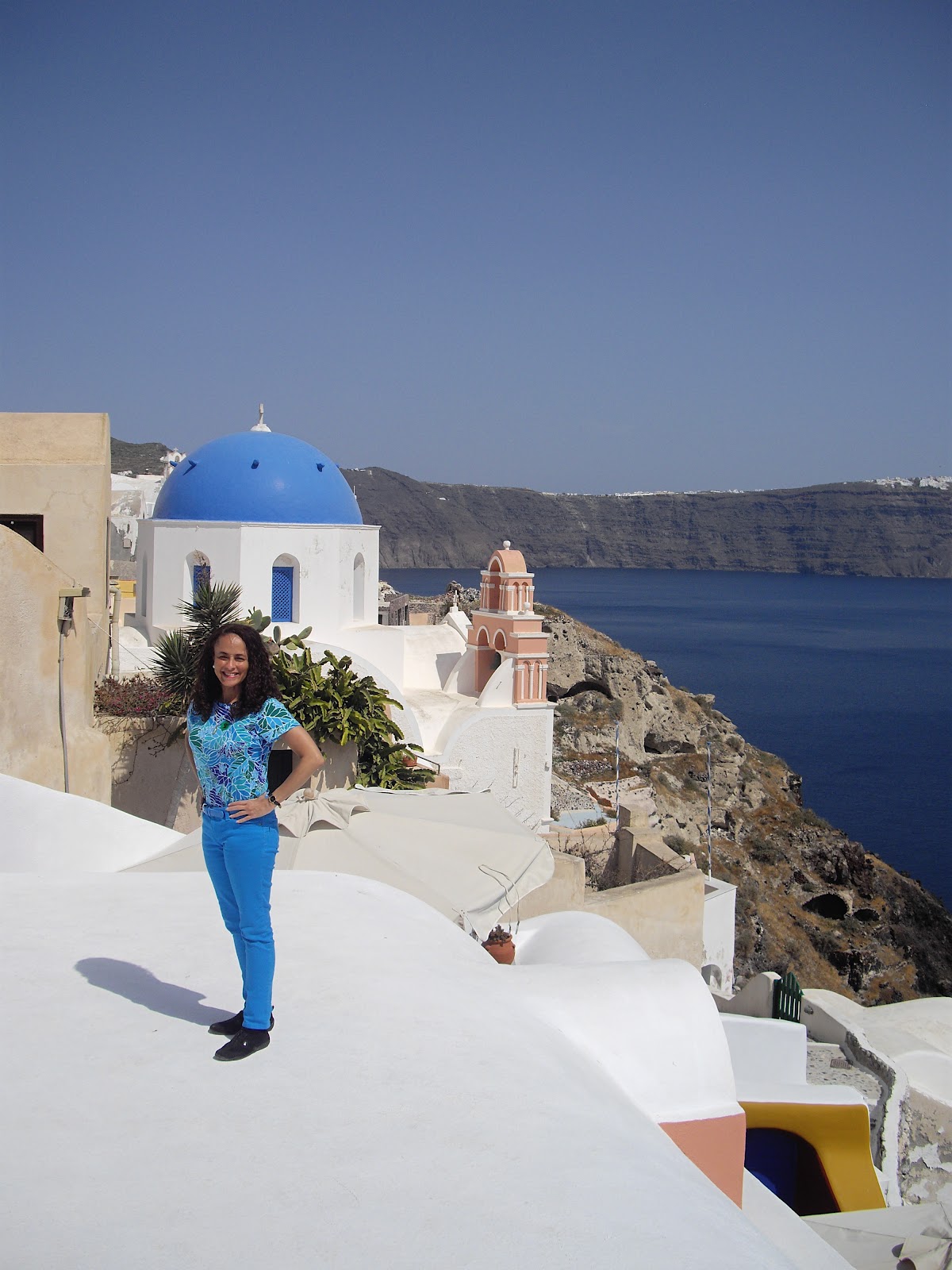
Today, I visited the Geek Island of Santorini where I saw some of the most exquisite natural beauty I have ever seen.  A popular reason for coming to Santorini is for its legendary views of sunsets, some of the most spectacular in the world

Santorini, named for St Irene, contains 13 communities perched atop cliffs formed by volcanos.  All feature white-washed buildings, blue domed churches, stepped streets, and sun-drenched terraces. The lush landscape is filled with vineyards, fig trees, caves, and churches

Ships tender passengers to the port of Skala Fira, a sheer 1000 feet below the capital of Fira.  To reach the top, one has 3 choices: climb (up or down later) the 588 zigzagging steps, ride one of the hundreds of mules up,  or take the cable car, (built only in 1982).  I was on the bus to Fira and opted to take the clean and modern cable car down to the ship.

Our tour began as we were tendered to the port of Athinios where we boarded buses to begin our tour.  Our first stop was a Cliffside vineyard that gives winemaking and wine tasting tours.  Most important were the spectacular views of the caldera and turquoise Mediterranean sea.  Our ship, The Equinox, featured prominently in views of the azure sea.

Oia


Next to drove to the village of Oia made world famous by the iconic photos of the blue-domed white washed church.  It is known for its breathtaking sunsets and stunning views and sun-kissed white-washed buildings. 


Fira

Fira is the capital,  whose white cobblestone streets bustle with shops, tavernas, hotels and cafes, while clinging to the rim of the caldera nine hundred feet above the its port.


As I explored Fira, I had one of the most delectable gyros ever!

Here are some facts about Santorini I learned from our tour guide:

It has more than 400 churches, many privately owned by families who only open them for special occasions.

Santorini is small with a population of only 15,000 residents who host one million tourists per year.

Santorini’s unemployment is close to zero.

The cable car linking the port to the Capital, Fira was constructed in 1982.  Prior to that year, there were 2 methods of climbing up : walking the 588steps or riding a donkey up

Known for its prolific wine industry producing dozens of varieties, Santorini is known to produce more wine than water. 

There is beautiful countryside where tradition still survives. Cave houses (both abandoned and occupied), gardens, vineyards, small family business, and tiny churches are there to be discovered.

Perhaps on my next visit, I will be brave enough to climb the 588 zigzagging steps to the top or to ride one of the fearless donkeys.

Tuesday, November 29, 2011

Olympia, Greece-site of the ancient Olympic Games

Today, our ship stopped in Katakolon, a small port located in southern Greece known for its proximity to the ancient site of Olympia—yes, THE Olympia where the ancient Olympics began in 776BC and lasted more than 1200 years. The games began as a tribute to Zeus and to celebrate character and balance of body and soul, as well as beauty and nobility.

At a time when incessant wars between city states were causing massive destruction and death, the King of Greece decided to call a truce and allow its best soldier athletes to fight on an athletic battlefield. Initially, the contests were divided into those in the nude and horseracing. The first nude races were footraces and gradually grew to include a pentathlon of sports of military skill in 706BC: javelin, discus thrower, jumping, wrestling, and foot racing. Later, boxing and chariot races were added.

Winners, who wore a wreath from the sacred olive tree, were transformed into virtual gods when they returned home, heralded as heroes for a lifetime. Strict rules governed participants requiring them to be Greek citizens, devoid of accusation of murder, and violation of game rules. In addition, judges, athletes’ trainers, and spectators followed a rigid set of requirements.
Women, who had their own competition before or after the games, were not allowed to be spectators.

We visited both the archeological site and the museum that houses artifacts excavated from the site.

The Archeological Site

Here we saw the gymnasiums, temples were prayers and sacrifices were offered, Olympic village, the race track, and more. We even took photos from the original footrace starting blocks.

Today, Olympic flame of the modern-day Olympic Games is lit by a reflection of the sunlight in a parabolic mirror at the restored stadium and then transported by torch to the place where the games are held. The first such torch was carried to Berlin in 1936. In 2012, the flame will be carried from this very spot to London.

The ancient Olympics ended 393AD when the Christian Emperor banned all form of pagan worship including these international games. Later, earthquakes, northern invaders, and flood damaged and eventually covered the site under 12 ft of silt. It is a wonder the site was excavated and rediscovered by a monomaniacal German archeological team beginning in 1875.

The modern Olympics were revived and were held for the 1st time in centuries in Athens in 1896 with 44 contests and 13 countries. Subsequent Olympics were held in Paris, St Louis, London, Stockholm, Antwerp, Amsterdam, LA, Helsinki, Melbourne, Rome, Tokyo, Mexico City, and so on.

The games were only stopped during WWI and WWII.

After we toured the site, we toured the impressive (nearby) archeological museum that houses hundreds of spectacular artifacts including statues, helmets, coins, terra cotta objects, and gold items.

Our visit ended with a stroll among the harbor front cafes and shops. Efharisto, parakalo, kalimera. I still remember a bit of Greek!

We had perfect sunny, cool weather for our tour with a knowledgeable, passionate, humorous guide.

I will certainly have special thoughts about the Olympics from now on………….

Photos are coming later!

Wednesday, September 28, 2011

Rhodes, The Perfect Port City


Today, I visited Rhodes, a walled city that is the largest permanently inhabited medieval city in Europe. Rhodes is the name of the city as well as the Aegean island and consists of three different cities: ancient, medieval, and modern and the old town is a UNESCO World Heritage Site. Of course, it is best known for the Colossus of Rhodes, one of the seven Wonders of the Ancient World, that stood in the old harbor until it collapsed in an earthquake in 227 BC, after dominating the harbor for 56 years. It is also known for its splendid beaches and 300 days of sunshine a year.

As I left the ship, I noticed Hop On Hop Off Buses just outside the port entrance (stop #8). Although I had studied all the maps and planned to take a self-guided tour of the Old Town, I decided to begin my journey with an hour long scenic circuit of the entire city (including up to Monte Smith) atop the tour bus, listening to a guided lecture. As always, I learned a lot and succeeded in getting an overview of both old and new, I would not have been able to conquer on foot.

Once I was satisfied I had a nice overview, I descended the bus (at stop #6) close to the stop where I boarded and near the Old Town central market, adjacent to the knights quarter. This was the perfect starting point for my walking tour of the (mostly pedestrian-only) Old Town. The well-preserved old town is divided into 3 quarters: knights, Turkish, and Jewish. I explored all 3.

The Avenue of the Knights, Ipoton, is the main thoroughfare of the knights’ quarter. This street is lined with the imposing Inns, residences of Knights of the Order of St John, that are divided by linguistic affinity, from each of the 7 groups that occupied Rhodes. I saw the French, Spanish, and Italian Inns, all that house archeological and decorative arts museums. I will explore Rhodes’ many museums on my next visit.

From here, I walked straight uphill to the Palace of Grand Masters, an imposing fort; built to be the last line of defense should the outer walls of the city be breached. Built on the site where the ancient Greek temple of Apollo stood, it was the residence of the Grand Master of the Knights, and where the Order assembled. After Rhodes fell to the Turks in 1522, it was converted to a prison and the palace was completely destroyed by an accidental explosion of stored black powder in 1856.

What is visible today as the Palace of the Grand Masters was rebuilt in the 1930’s based upon old drawings and it’s the complete reconstruction was undertaken to create the summer residence of Mussolini and King Victor Emmanuel III. Of note, it was never used for this purpose.

Next, I climbed the hill of the Mosque of Suleiman that was built soon after the Turks occupied the city of Rhodes in 1522 on the site of the destroyed Christian Church of the Apostles.

Just in front of the Suleiman Mosque is the old Turkish Bazaar that lines Sokratous Street, which is packed with tourists and a melee of shops that spill their wares into the street. I enjoyed exploring and bargaining. The shop owners are not annoyingly aggressive as in certain other cities.

Sokratous Street is a pleasant cobblestone street that is bound to be walked by every tourist who visits Rhodes. I took a slow walk through this street from the Mosque of Suleiman to the very lively Ippokratous Square which surrounds the Castellania fountain (birds are actually drinking from each of the faucets!!), and is framed by the old Chadrevan mosque on the west and the Palace of the Castellan on the east. All around, coffee shops and terraced-restaurants burst at the seams as they spill onto the street having completely covered the old buildings.

I returned to the ship to recharge my camera battery, find my ATM card, and grab lunch. I went back into Old Town for another 2 hours to explore more of the maze of nooks and crannies of this remarkably charming town.

When I return, I will take a trip to Lindos.

Tweet: Rhodes is the perfect port city: rich in history, U walk there from ship, it’s beautiful, it’s unique: a medieval walled-city & people smile

Chania, one of the most photographed cities in Greece


Today, I visited the city of Chania one of the most photographed cities in Greece. It is located on the island of Crete. I visited the charming old town with narrow, cobblestone streets; monuments and buildings dating to the 1500s, and a breathtaking harbor. The rain tried to ruin our day but did not succeed. You can see this in my photos.

Monday, September 19, 2011

Cruise to Israel, Greece, Turkey, and Italy


I will take this wonderful 13-night cruise that visits Israel (my first time), Greece, Italy (including Sicily), and Turkey. I look forward to a relaxing and intellectually stimulating time and to chilling out in my balcony room on a great ship!

Here is the route:

Sept 20 depart from Rome, Italy
Sept 21 Sea day
Sept 22 Chania, Crete, Greece
Sept 23 Rhodes, Greece
Sept 24 Sea day
Sept 25 Jerusalem (Ashdod) Israel
Sept 26 Nazareth (Haifa) Israel
Sept 27 Sea day
Sept 28 Ephesus, Turkey
Sept 29 Athens, Greece
Sept 30 Sea day
Oct 1 Palermo, Sicily, Italy
Oct 2 Naples,/Capri, Italy
Oct 3 Back to Rome and Flight back to Miami

Thursday, November 25, 2010

Crete instead of Athens on cruise today


Full Article coming soon…………..

Riots in Athens so ship went to Crete instead. It was a beautiful, sunny day in Crete. I took the local bus (2Euros) to visit The Palace of Knossos constructed 6000BC (6Euros). Then, I walked around the charming streets of Iraklion.

I feel bad for people who had Athens on their bucket list. Some had invested lots of time planning Athens tours. Glad I have been many times. I was here several years ago and stayed at the Creta Maris resort on the beach.

We saw young people rioting peacefully here (protesting I guess). Perhaps the are protesting University prices as they are in England.

Saturday, December 12, 2009

Cruise Vacation--Day in Athens

Athens

Today from our cruise ship, we visited Athens, the cradle of Western civilization and thought and birthplace of democracy, individual rights, and freedom of speech. The USA’s founding fathers were so enamored with the ideals and philosophies of Ancient Greece that they entertained making Greek the USA’s official language. European luminaries had even joined in the Greek War of Independence to help preserve the ideals of Ancient Greece.

One of my favorite things to do in Athens (my 4th visit here) is to tour the most potent symbol of the Greek Golden Age: The Acropolis. The Parthenon has inspired architects from around the world for more than 2500 years. It took 9 years to build this temple to Athena. (its too bad Turkish explosives bombed the structure in 1687). I love that the Parthenon so dominates the soul of the city, you can see it morning, noon, and night from throughout the city. We were fortunate that the rain held off til AFTER our Acropolis visit!

A stop at the Temple of Zeus was next. From there, we could see the landmark Parthenon perfectly.

Our tour guide, Peter, That Greece joined the EU in 1981. Their switch from the drachma to the Euro 8 years ago has had negative impact on their economy.

The 2004 Olympics were held in Greece for the 1st time since the modern Olympics were revived in 1896. Preparation for hosting the 2004 Olympics catapulted Greece into the 21st century bringing impressive new stadiums, an expanded subway system (today transports a million Greeks daily), a new airport, and tram lines. Of note, Greece completed construction the DAY before the Olympics.

The garbage strike that made internationals news was visible (everywhere. Our guide apologized.

Another of my favorite activities in Europe is to walk around the Plaka. The guide dropped us off at Thisio and I strolled through the cobblestone streets visiting shops for a couple of hours. Last on our itenerary was a visit to the newest (built June 2009) (and controversial) museum: The New Acropolis Museum.--A brand new modern structure designed to showcase Acropolis gems with a panoramic backdrop of the Acropolis. During our visit to this impressive museum, we witnessed the lighting of the Parthenon at sundown. It was stunning!

I will always look forward to visits to Athens, Greece!