Sunday, May 13, 2012

McDonald's Around the World


China

McDonald's has come a long way since it opened its first store in Des Plaines, Ill. With restaurants now in 119 countries, McDonald’s is omnipresent and, well, unavoidable. As a traveler, you can sniff at the spread of Americanized fast food, or you can embrace it. How many of us have wandered into a McDonald’s overseas just to find a taste of home? What we find is sometimes surprising: Stop by a restaurant in Germany and order a beer. In Canada you may find a lobster roll. In Hawaii, order a deluxe breakfast that has rice with a side of spam. Burgers, fries and shakes are almost always on the menu, but if you look, you’ll see differences in the menu, the architecture and even good ol' Ronald the clown.


 In China, it’s Ronald McDonald versus Colonel Sanders as McDonald’s and KFC fight it out for fast-food dominance. (KFC is so ubiquitous here you’ll see it on the corner of Tiananmen Square.) McDonald’s reportedly plans to expand to 2,000 restaurants in the country by 2013. There’s definitely an appetite for Western-style food in Beijing, Shanghai and beyond, as the menu features many of the most familiar items, such as Big Macs and fries. There’s a strong focus on chicken and fish as well, and you can order a McFlurry at the Express window.


Americans are used to seeing a waving Ronald McDonald, but in Thailand the clown mascot offers a more traditional greeting. Stop in for breakfast and you can order Bubur Ayam, hearty breakfast porridge with chicken, chilies and onions. Lunch could be a samurai pork burger, a double Big Mac (think four patties, super tall) or a McSalad Shaker — put all the ingredients in a cup with a lid, add dressing and shake. Voila! If you’re in Bangkok and don’t feel like fighting the traffic from your hotel, you’re in luck: Thailand is one of the handful of countries where McDonald’s delivers.
Namaste in Thailand


Why order a regular McChicken when you can get a towering Chicken Maharaja-Mac? Or perhaps a McVeggie, a fried patty of peas, carrots, potatoes and savory Indian spices? Or the potato-based McAloo Tikka? All are standard menu items at McDonald’s in India, where the entire menu is beef-free. In the next few years, the company hopes to have as many as 250 restaurants throughout India, where there are 700 million hungry potential customers under 30 — many of whom take advantage of the online ordering and delivery service.


McDonald’s has been a longtime supporter of the Olympic Games since 1968, when the company first flew food to American athletes homesick for burgers in Grenoble, France. These days, as a sponsor of the London Olympics, McDonald’s is celebrating by rolling out Happy Meal toys of the Olympic and Paralympic mascots, and is opening what will be the biggest and busiest McDonald's restaurant in the world — a two-story building that seats 1,500 customers, ten times the average McDonald's. If you're lucky enough to visit there during the Games (this temporary restaurant is for the Olympics only), try a Cadbury Crème Egg McFlurry or that most classic of English breakfasts: porridge.


Pull into any of the prevalent McDonald’s in Dubai, United Arab Emirates, and try the localized version of a burger: The McArabia sandwich, grilled chicken on pita bread with black seeds, covered in traditional mayonnaise garlic sauce. The Chicken Big Mac is also popular. Dubai McDonald's also deliver, with a "green" twist: The vegetable oil from area's restaurants are converted into biodiesel that fuels their delivery vehicles.


When Russia’s first McDonald’s opened in 1990 on Pushkin Square in Moscow, it made international headlines. It served 30,000 customers that day — a record — and it remains one of the 10 busiest McDonald’s in the world. (The Pushkin McDonald’s is also huge, with 28 registers and seating for 700.) McDonald's has since expanded to other cities in Russia, and customers flock for hamburgers, shakes, the McTasty and of course, cabbage pies.


Looking for the nearest McDonald’s in Tokyo? Ask for directions to Ma-ku-do. They’re easy to find: After the United States, Japan has the most Ma-ku-dos of any country in the world. (America still dominates with 14,000-plus.) Along with your green tea, you can order an Ebi Burger (a panko-crumb encrusted shrimp deep fried into a burger patty), or the Mega Tamago, a promotional burger that has a fried egg on it. The McHotDog Chili is — you guessed it — a chili dog. One blogger in Japan reported on a new item that (hint, hint!) would also be a hit in the U.S.: a bacon and mashed potato pie.

 
Japan


Passers-by have to look closely to see the golden arches on this unassuming white building on a street near Fish Square in Bergen, Norway. Many of the menu items inside are familiar, but one popular item some years ago was the Lakse fish wrap with your choice of wasabi or honey sauce. While the food is modern, the building dates to the 1800s, and the company made sure the exterior was preserved to blend in with the surrounding historic buildings.


Norway


Italy, famous for its Slow Food movement that promotes home cooking with organic, regional ingredients, opened its first McDonald’s in Rome in 1986 near the legendary Spanish Steps. It was the opening of that restaurant, in fact, that launched the whole movement — but it didn’t stop hungry tourists and locals from visiting McDonald’s restaurants as they grew across the country. Some, like this one in Sicily, sport the chain’s familiar red and yellow colors, but others are decidedly sleeker — appropriate, say, for fashionable Milan. Also appropriate? The Parmigiano Reggiano burger made with ciabatta bread and a slide of the famous Italian cheese.


The arrival of McDonald's at Berlin's famous Checkpoint Charlie in 2010 caused some to nickname it Snackpoint Charlie. (There's also a Starbucks, pizzeria, sushi bar and more in the area.) Regardless, it seems the perfect bookend to a story of a divided city, where American and Russian tanks once squared off, and where a large stone wall was a dark daily reminder of the Cold War.
by Heidi Schuessler
Checkpoint Charlie

Sunday, May 6, 2012

Istanbul


Istanbul


I experienced one of the most wonderful visits to one of the most historically significant cities in the world. I chocked as much into a day and a half as is possible and found every minute invigorating. For 2 days, we visited Istanbul, the only city in the world, which straddles both Asia and Europe (split in two by the Bosporus Straights).


A special aspect of the visit was having spectacular views (from our ship) overlooking the Bosporus Straight (and Golden Horn) of key sites including Hagia Sophia, Topkapi Palace, and The Blue Mosque with its 6 minarets. I had breakfast and dinner overlooking this spectacular water view.


Because Istanbul IS a port city, we had easy access from the ship. Within minutes (or a short tram ride) a cruise passenger can enjoy major sites. On our second day, I took the tram from Trophane to Eminonu, to begin my tour. I loved the frenetic energy of the city and felt comfortable touring around on my own, day 2.


Touring around, I felt the glory/power of this once mighty city that served as capital of two of the world’s most powerful empires Byzantine (for 900+ years) and Ottoman Empire (for 600+ years). The Ottoman Empire was an economic, military, and religious powerhouse that ruled a huge chunk of the world spanning, Europe, Asia, and Africa from the 14th till the 20th century.


As we docked in Istanbul in the early morning, we were greeted by a robust and lively folk band of musicians dressed in traditional Turkish decorative uniforms. I was able to zoom in and capture great close ups of them right from my private balcony.


I met my private tour group (of threee couples I met online) in our usual spot, across from the tour desk on deck 3.


We joined our tour guide, Ozlem (ozlemaydin33@gmail.com), who directed us to our bus, whose driver took us directly to the site-filled area: Sultanahmet. Sultanahmet is the Old Town, where the city’s top landmarks are concentrated---including Hagia Sophia, Topkapi Palace, The Blue Mosque, The Basilica Cisterns, Hippodrome Square, and the nearby The Grand Bazaar.


Here are some comments/reflections about my time in Istanbul:


We only used the bus twice: at the beginning and end of our day. Traffic was very congested (a new James Bond movie was being filmed) and the Old Town is best explored on foot.


Sultanahmet Park, situated between the Hagia Sophia and Blue Mosque, provides a great photo opp for both grand structures.


The Hagia Sophia is one of the most impressive buildings in the world and the crowning achievement of the Byzantine Empire. Constructed by Emperor Justinian during the 6thcentury, it remained the largest basilica in the world for centuries and the remains the worlds 4th largest ever built. It served as the Patriarchal church of Constantinople nearly a millennium until the Ottomans captured Constantinople in 1453. Although the Ottoman Turks were Muslim, they were so captivated by the cathedral’s grand scale and beauty, they chose to preserve rather than destroy it. Instead, they converted it to a mosque adding minarets, covering Christian mosaics and frescoes with Islamic artwork, and adding an imam’s pulpit and mihrab facing Mecca, among its many modifications. After the secular Republic of Turkey was established, the Hagia Sophia was converted to a museum in 1936. As a result, many (well-preserved), original Christian frescoes, which had been plastered over with whitewash, were uncovered and are now on display. The eight iconic 24-ft wide leather medallions with Arabic calligraphy continue to dominate the apse, center and arches above the imperial gate.


The Blue Mosque was the first mosque outside Mecca to have six minarets, likely a display of the Sultan’s wealth. In order to avoid upstaging the central mosque in Mecca, which had six minarets, Sultan Ahmet I financed construction of a seventh minaret there. Construction of this mosque marks the beginning of the Ottoman Empire’s decline because it exhausted the treasury that was never restored due to a succession of wars and incompetent rulers.


I saw the famous Medusa heads in the underground Basilica Cistern (the vast, dimly-lit, former underground water reservoir, built in the 6th century).


The Waterway intersection of The Golden Horn, Bosporus Straight, and Sea of Marmara is one of the busiest in the world. There was a continuous flow of ferry, barge, commercial ship, cruise ship etc. traffic. With its spectacular views, it’s no wonder that Sultan Mehmet The Conqueror chose to this prime location on which to build his Topkapi palace.


We had a delectable and inexpensive lunch at Buhara 93 (Nakilbend Caddesi 15-near the Hippodrome). I ordered the chicken Kebab with rice and salad for 8 or 9TL. They have open wood-fired ovens where you can watch men baking the famous lavas (flat bread). (It really is mentioned in Rick Steve’s guide, as their sign says)


Ozlem (our tour guide) and Karla

I found the vendors at the Grand Bazaar (and Spice market) to be in-your-face aggressive. The whole experience can be a bit overwhelming at first, but, the loud, colorful, crowded covered malls grow on you after a while. The opening line in Turkish bazaars is always, “Where are you from”? I am always delighted when vendors cannot guess where I am from since they are generally skilled at discerning the heritage of tourists. My favorite line was, “How can I hassle you today?”. My favorite sign was “Real Fake Watches Sold Here”. There are more than 4000 stalls in a maze of streets in the grand bazaar selling carpets, ceramics, jewelry (gold, silver, precious/semi-precious stone, byzantine replicas), textiles, copperware, mosaics, spices, Turkish handicrafts, clothing, water pipes, Turkish delights, Evil eye merchandise, and of course, souvenirs, and more.


On my next visit, I will go to the bustling Taksim Square and Istikal Cadessi (Street) via the tram and funicular.

Thursday, May 3, 2012

Santorini, Greece


Santorini


Today, I visited the Geek Island of Santorini where I saw some of the most exquisite natural beauty I have ever seen.  A popular reason for coming to Santorini is for its legendary views of sunsets, some of the most spectacular in the world

Santorini, named for St Irene, contains 13 communities perched atop cliffs formed by volcanos.  All feature white-washed buildings, blue domed churches, stepped streets, and sun-drenched terraces. The lush landscape is filled with vineyards, fig trees, caves, and churches

Ships tender passengers to the port of Skala Fira, a sheer 1000 feet below the capital of Fira.  To reach the top, one has 3 choices: climb (up or down later) the 588 zigzagging steps, ride one of the hundreds of mules up,  or take the cable car, (built only in 1982).  I was on the bus to Fira and opted to take the clean and modern cable car down to the ship.

Our tour began as we were tendered to the port of Athinios where we boarded buses to begin our tour.  Our first stop was a Cliffside vineyard that gives winemaking and wine tasting tours.  Most important were the spectacular views of the caldera and turquoise Mediterranean sea.  Our ship, The Equinox, featured prominently in views of the azure sea.

Oia


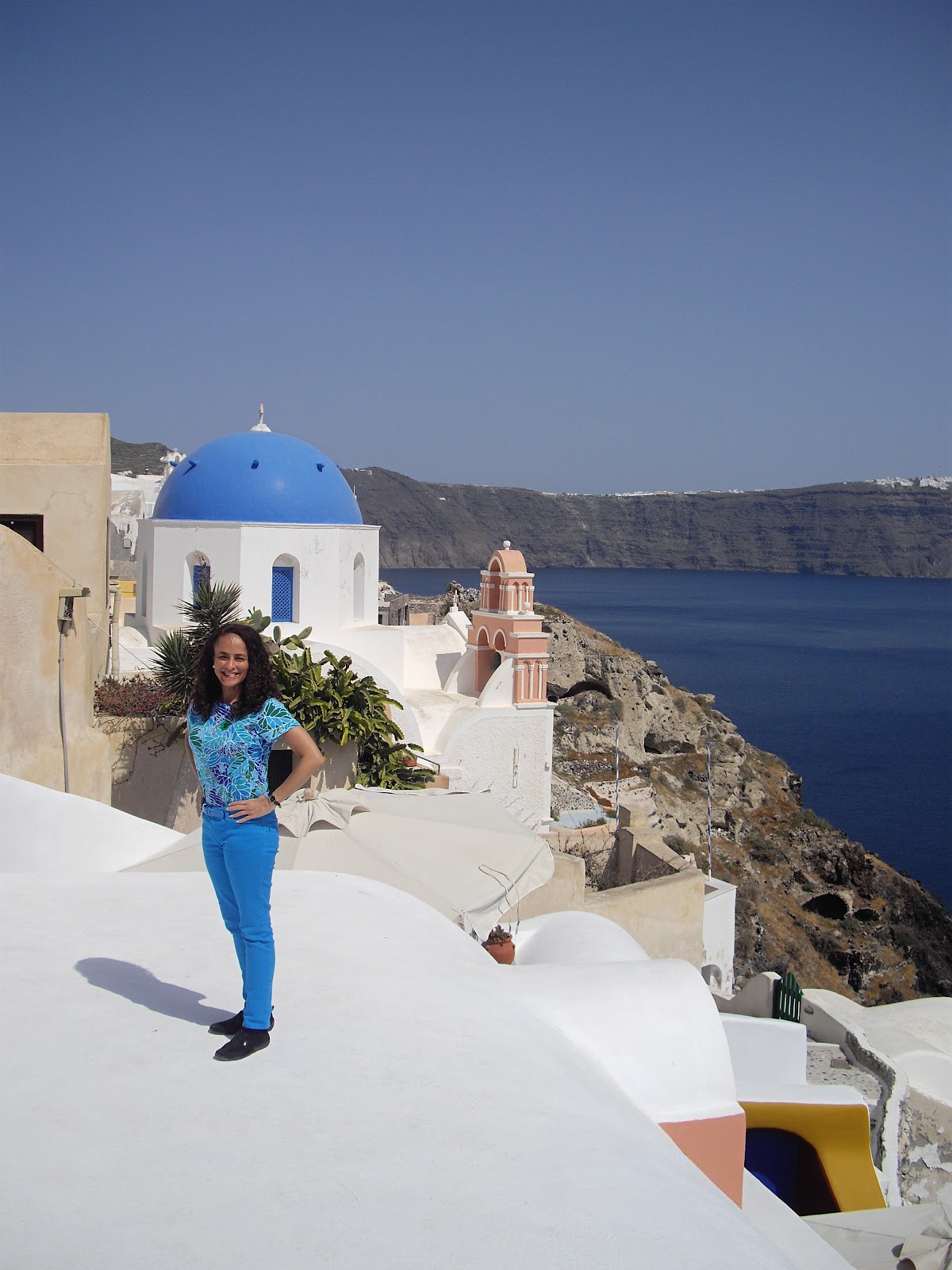
Next to drove to the village of Oia made world famous by the iconic photos of the blue-domed white washed church.  It is known for its breathtaking sunsets and stunning views and sun-kissed white-washed buildings. 


Fira

Fira is the capital,  whose white cobblestone streets bustle with shops, tavernas, hotels and cafes, while clinging to the rim of the caldera nine hundred feet above the its port.


As I explored Fira, I had one of the most delectable gyros ever!

Here are some facts about Santorini I learned from our tour guide:

It has more than 400 churches, many privately owned by families who only open them for special occasions.

Santorini is small with a population of only 15,000 residents who host one million tourists per year.
Santorini’s unemployment is close to zero.

The cable car linking the port to the Capital, Fira was constructed in 1982.  Prior to that year, there were 2 methods of climbing up : walking the 588steps or riding a donkey up

Known for its prolific wine industry producing dozens of varieties, Santorini is known to produce more wine than water. 

There is beautiful countryside where tradition still survives. Cave houses (both abandoned and occupied), gardens, vineyards, small family business, and tiny churches are there to be discovered.

Perhaps on my next visit, I will be brave enough to climb the 588 zigzagging steps to the top or to ride one of the fearless donkeys.

AZORES-PontaDelGada-Day 7 on a transatlantic cruise to Europe

Today, I took a private group tour of Ponta Delgada in the Azores, a Portuguese archipelago of 9 lush volcanic islands.  It is situated in the Atlantic Ocean and considered the Westernmost point of Europe.
We toured Azores’ lush mountainsides, hot springs, waterfalls, parks, blue& green lakes, and countryside populated by smiling cows..  Highlights were visits to Sete Cidades with its famous blue and green lake and Caldeira Velha, a warm waterfall tempting its visitors to take a bath, surrounded by fern trees and a hot spring with boiling water.


Photos will be posted later.


Friday, March 30, 2012

7 Tips to Ensure You’re Understood when Speaking to a Foreign Audience


by Leon Potgieter.


“Americans who travel abroad for the first time are often shocked to discover that, despite all the progress that has been made in the last 30 years, many foreign people still speak in foreign languages.” – Dave Barry


The phrase “tough crowd” takes on an entirely new meaning, with deeper shades of terror-inducing nuances, when public speakers face an audience made up of individuals who do not share the cultural background and world-view of the person behind the microphone. As a Westerner living in an Asian country, where more than 80% of the population does not speak English as a first or second language, I’ve learnt the necessities for communicating across cultural barriers. Below I’ve outlined some practical and easy-to-implement tips for anyone addressing an audience of ‘foreigners’.

Use these for minimizing inevitable cross-cultural misunderstandings and appealing to a larger crowd.

1. Understand cultural assumptions – yours and theirs
Being human and all that, most of us automatically assume that our cultural norms are universally upheld and are often left confused when people don’t share our axioms. A simple overview of basic cultural assumptions would be enough to give you the knowledge you need to avoid most serious miscommunications.
International Business Etiquette courses are usually excellent for this sort of education. Barring that, the Internet can be a great help: ExecutivePlanet.com is a Wiki-style online business etiquette encyclopedia with helpful and concise culture tips for nearly 50 countries.

2. Use humor wisely
I’m a big fan of using humor in almost any kind of speech, but with non-English speaking audiences, most kinds of wittiness (1) do not translate well, (2) might even end up being inappropriate. Humor should be used wisely and preferably tested before incorporated into a speech of this sort.

A few years back, I saw a friend addressing a crowd of young Ukrainians. He was telling the story of Lance Armstrong and his rise to cycling-fame after his cancer diagnosis. In attempting to capture his remarkable recovery and near instant-success, my friend used the phrase “Zero to Hero” which, after translation drew blank stares from the crowd. Witty slogans like those might sounds funky in English, but will often be virtually meaningless in Polish, Korean or, as in this case, Ukrainian!

3. Work with your interpreter
I once spoke to a small group of Koreans and was to be accompanied by a seasoned interpreter. She asked to meet with me a few weeks before the delivery and asked for a copy of my speech draft. At a second meeting thereafter she had many questions and clarifications about certain words, phrases and content. I gladly helped and her interpreting on the big day was naturally excellent. It’s thus often a good idea to present your interpreter with a copy of your speech notes a while before the delivery, to help him/her with preparation.

The great, often overlooked benefit of working with interpreters is the natural pauses you automatically get between sentences. These are wonderful little time-frames you can use to gather your thoughts, pre-determine your next sentence and glance at your notes.

4. Skip the gobbledygook, completely
Jargon, unnecessary technical terms, geek-speak and “marketese” should be avoided like the plague. If English speaking audiences find excessive use of these confusing, how much more our crowd of focus! Non-English speakers won’t rave about your “quality transitional contingencies” since they probably have no clue what you’re talking about!

5. Speak to 12 year olds
A useful rule of thumb is to assume that English second language speakers in a non-English speaking country are able to understand at the level a 12 year old that grew up in an English country. That means that your ostentatious and delineative enunciations are better left at home and that you speak plainly and simply with clear and direct language. If a 12 year old won’t understand it, scratch it and simplify! Skip the PhD-isms, and avoid using complex and obscure sentences. See Wikipedia’s Simple English Pages for ideas on writing for non-English speakers.

6. Watch out for language nuances
Direct or forceful language is often considered rude in many honor-system countries like those of the Far East. Educate yourself on the aspects of your audience’s worldview (see #1 above) to avoid accidentally falling into the trap of offending them.

Personally, being of German/Dutch descent I grew up in a culture where indirect and vague speech is viewed with suspicion (“What are you hiding?”). And yet, living in east-Asia my to-the-point demeanor and no-nonsense approach to conversation has often been interpreted as aggression and I’ve thus had to learn to adapt my speech. You might find yourself in a similar situation when speaking to a foreign audience, so be careful of language nuances.

7. Use local terminology
I’ve heard so many Americans addressing “metric” crowds and talking in yards, miles and pounds, leaving the rest of us clueless. Similarly talking about 8th graders and 12th graders means nothing to the rest of the world. Localize your words, sentences and even your stories and parables – it makes you more approachable as a speaker and shows sensitivity and sophistication to the audience. If they notice it, they’ll appreciate it.

However, if you choose to incorporate local words or phrases in your speech, please for the love of sanity, practice your pronunciation! I’ve been at events where speakers, in an attempt to impress the crowd, have used words from the local language only to end up sounding terrible and completely incomprehensible to the audience. Don’t invite confusion – instead ask a local to listen to and help you with pronunciation. It’s better to say ‘Good Morning’ in plain English, than “Konichiwa” in Americanized Japanese that ends up sounding like “Go-knee-cheese-wow”!
———————–
Leon Potgieter is an English Teacher, Christian Minister and Public Speaking Enthusiast who’s been living in the Republic of Korea since 2008. His website effective-public-speaking-tips.com is an ever growing online portal for public speaking tips, speechwriting help and presentation techniques.

Monday, February 13, 2012

Old Money Helps Spanish Village Stay Afloat


Here is an article describing a Spanish town’s beneficial return to the use of the peseta.

Old Money Helps Spanish Village Stay Afloat by Lauren Frayer

Villamayor de Santiago, population 2,500, is a small village just south of Madrid, Spain.

It's famous for three Manchego cheese factories and a windmill that stopped turning decades ago. More than one-third of the town is unemployed.

After Christmas, shopkeepers decided to jump-start their economy.

"We realized there's no money here — well, no euros anyway — in the pockets of our customers," says Luis Miguel Campayo, head of the local merchants' association.

So, he floated an idea: Just for a month, do business in pesetas — a currency that hasn't been in use in 10 years. Campayo had a hunch the town's aging population might have some old currency squirreled away.

"People kept their pesetas because of this romantic attachment to the past," he says — and just in case the euro folds.

So 30 shopkeepers signed on to accept pesetas and hauled out their calculators. One of them was José María Caballero, who runs the local drugstore.

"A lot of people are coming in," he says. "Including people with big bills, for 1,000 or even 5,000 pesetas."

That's about $50 — a lot to keep stashed in your closet. Caballero says shopkeepers made the equivalent of about $8,000 in peseta sales in January, so they extended the campaign through February.

"When we finish our promotion later this month," he says, "we'll change the pesetas for euros, then hand out what everyone earned."

Unlike other eurozone countries, which set deadlines for turning in old money, the Bank of Spain in Madrid still accepts pesetas for euros — at the old 2002 rate. It estimates there are more than $2 billion worth of pesetas still out there somewhere — like in 94-year-old María Martinez's pocket.

She says the pesetas fell out of a pocket in an old skirt when she was packing up to move into the nursing home where she lives now.

The nurses there say some of their elderly residents don't realize pesetas disappeared 10 years ago, but Martinez has her wits about her.
Asked if she'll spend those pesetas now, in a shop around the corner, she says no, she'll just keep them as a souvenir.

"Nowadays things are different," she says, fumbling for some euros in her purse.

http://www.npr.org/2012/02/12/146754766/old-money-helps-spanish-village-stay-afloat?sc=17&f=1004